1.What Is Face Tracking Video Editing And Why Creators Should Care:
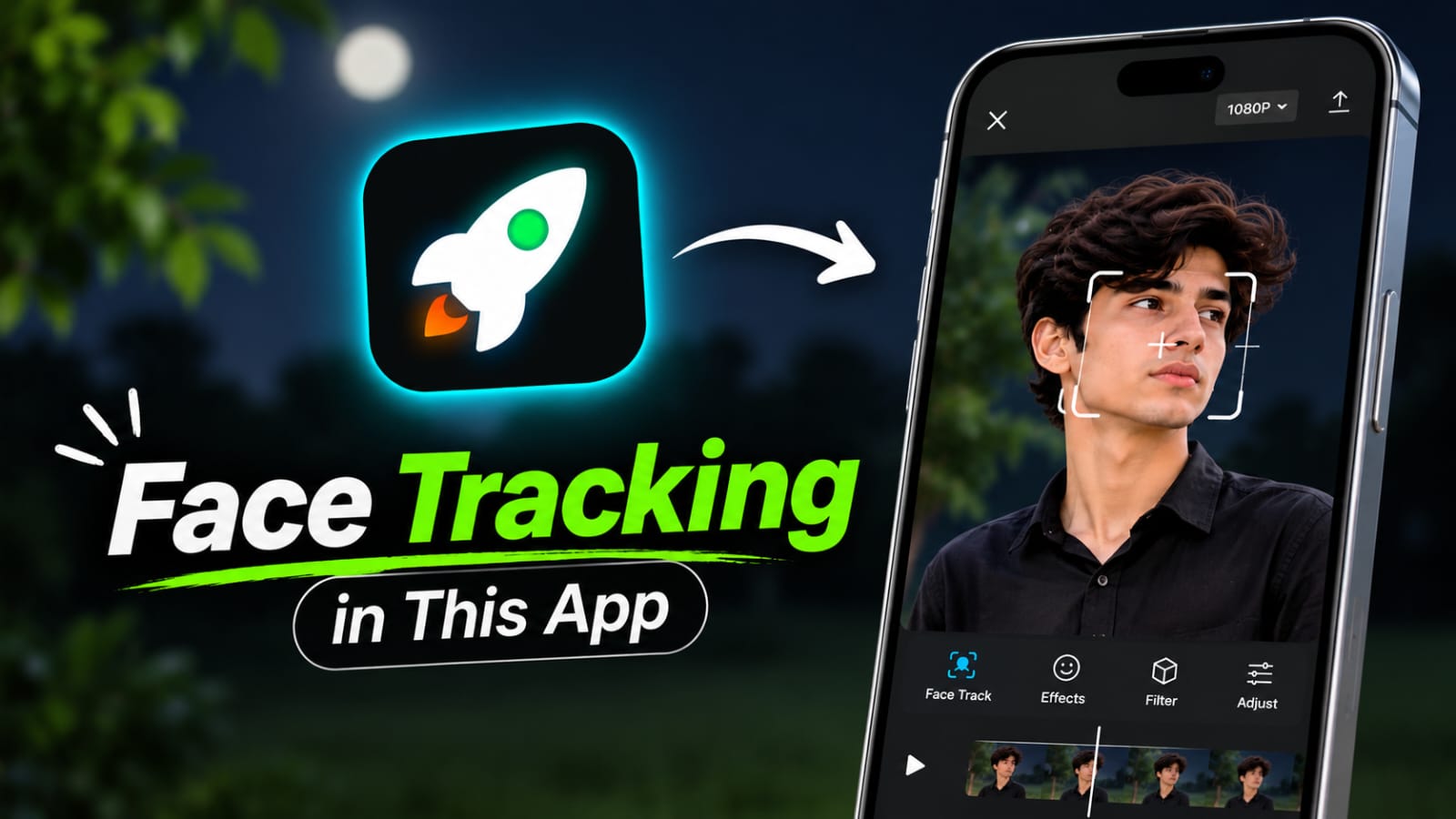
Facial tracking video editing constitutes a sophisticated technological framework that identifies and monitors specific anatomical landmarks including the ocular region, nasal bridge, oral aperture, and mandibular contourwithin recorded media to facilitate the real-time attachment of digital overlays to a subject’s visage.
Rather than relying on the labor-intensive process of manually keyframing individual movements, content creators delegate the frame-by-frame tracking to automated algorithms, ensuring that visual modifiers such as masks, filters, decals, typographic elements, or three-dimensional objects remain rigorously anchored to the face.
Maintaining precise alignment regardless of the subject’s locomotion, rotation, or dynamic facial expressions.For content creators, this innovation is transformative as it dismantles one of the most formidable obstacles to crafting refined, captivating material: the relentless consumption of time.Tasks that formerly demanded hours of arduous.
Manual post-production can now be accomplished within moments, thereby accelerating publication rates and liberating creative energy from mundane, repetitive labor.Furthermore, facial recognition technology unlocks a spectrum of creative potential previously inaccessible to independent producers.
Ranging from whimsical beauty filters and animated masks to advanced applications such as digital makeup, face swapping, and immersive augmented reality overlays Beyond mere convenience, facial tracking serves as a pivotal mechanism for creators to distinguish themselves within the saturated landscape of social media.
In an environment where audiences rapidly scroll past content, dynamic and visually arresting material commands superior attention and engagement.By transforming videos into more entertaining, shareable, and memorable experiences, these effects directly catalyze growth.Furthermore, this technology democratizes production.
Affordable applications now provide professional-grade effects to any smartphone user, rendering dedicated studios and extensive visual effects teams obsolete.
2.How face tracking works in Mobile Video Editing Apps:
Mobile video editing applications leverage front or rear cameras, integrated with proprietary machine learning frameworks like Apple’s Vision and ARKit or Google’s ML Kit on Android, to execute precise face tracking.
Upon directing the camera toward a subject, the software identifies critical facial landmarks often comprising.
68 or more points that delineate the eyes, nose, mouth, jawline, and eyebrows.By continuously monitoring these coordinates across successive frames, the application maintains real-time spatial awareness of the face, accurately capturing its position and dynamic movements regardless of how the user turns, tilts, or adjusts their proximity to the lens.
Upon securing the facial landmarks, the application constructs a lightweight three-dimensional mesh that serves as the anchor for filters, masks, stickers, and visual effects, ensuring they adhere convincingly to facial features rather than drifting across the display.This mesh dynamically tracks expressions in real time.
A capability that enables virtual spectacles to remain precisely positioned on the nose and animated ears to stay firmly attached to the head during movement.Furthermore, contemporary applications predominantly execute these computational tasks on-device, thereby minimizing latency and allowing users to preview effects live while recording.
The fidelity of facial tracking hinges upon several pragmatic variables.Optimal illumination enables the application to resolve intricate facial contours, while maintaining a stable, unobstructed line of sight prevents landmark drift.Conversely, rapid gestures or incomplete facial visibility often induce slippage or latency.
Consequently, numerous applications employ smoothing algorithms and predictive modeling to mitigate these instabilities.Beyond the core tracking mechanism, applications integrate beauty retouching, background segmentation, and motion-driven effects, all of which derive from the identical facial data set.
This unified architecture allows a singular tracking engine to drive a spectrum of outcomes, ranging from subtle dermal refinement to whimsical animated overlays.Consequently, a comprehensive grasp of this processing pipeline empowers creators to compose shots that ensure robust tracking performance and to select effects that harmonize seamlessly with their on-camera kinetics.
3.Key Features to look for in a Face Tracking App:
When evaluating face-tracking applications, it is essential to prioritize features that yield tangible results in routine post-production.
Paramount among these is tracking precision and steadfast stability a competent application must secure a robust lock on the subject’s visage, maintaining that fixation regardless of head rotation.
Rapid movement, or transient occlusion by the frame’s edges.Unstable tracking that manifests as jitter or drift can irrevocably compromise an otherwise exceptional clip; therefore, rigorous testing of the application’s performance under dynamic motion conditions is imperative before finalizing your selection.Subsequently, one must evaluate.
The spectrum of effects and filters offered by various applications.While certain platforms are dedicated primarily to beauty retouching, others excel in providing playful masks, three-dimensional stickers, or augmented reality overlays.Deliberation regarding the nature of the content you produce is essential when selecting an application.
Whose effect library aligns with your distinctive stylistic approach.Furthermore, it is advisable to assess the frequency with which new effects are introduced, as a consistently expanding repository ensures that your video content remains contemporary and engaging.Convenience constitutes a paramount consideration.
When editing on mobile devices, the interface must facilitate the application and refinement of tracking via merely a few taps.Seek applications that incorporate automatic facial recognition, customizable tracking coordinates, and live previews, thereby allowing you to visualize the precise outcome of an effect prior to final export.
Given the scarcity of time, an intuitive application can save considerable hours across the duration of a project.Consequently, prioritize the app’s export quality and performance metrics.The utility of a face-tracking application is intrinsically tied to the fidelity of the resulting video.
Therefore, verify that it facilitates high-resolution exports without compromising the integrity of the original footage.Additionally, evaluate the application’s operational fluidity on your specific hardware, assess whether it provides a watermark-free output, and scrutinize its pricing structure.Utilizing free trials constitutes an prudent.method for comprehensively testing these capabilities prior to committing to a solution for your professional editing workflow.
4.Best Face Tracking Video Editing Apps for Beginners:
For those newly embarking on the journey of face tracking, there is no necessity to immediately adopt professional-grade software characterized by an arduous learning curve.Instead, a range of user-friendly applications enables the seamless integration of face tracking effects into video content.
Avoiding the complexity of intricate configuration options.Among the most approachable tools for novices, CapCut stands out by offering robust functionality across both mobile and desktop platforms.It integrates sophisticated face-tracking capabilities, enabling users to seamlessly anchor stickers.
Textual overlays, or visual effects to a moving visage through mere taps.Furthermore, its intuitive interface fosters a creative environment where experimentation can occur without the apprehension of unintended errors.Individuals who opt to edit content on mobile devices will find that applications such as VN Video Editor.
And InShot offer accessible face-tracking functionalities integrated with their primary editing suites.Catered specifically to the needs of casual creators, these platforms prioritize intuitive controls and expedited output, ensuring that the creative process remains both efficient and uncomplicated.
Click Here
Filmora emerges as a robust alternative, effectively harmonizing user-friendly accessibility with substantial creative latitude.Its face-tracking functionality is intuitively designated and straightforward to implement, positioning it as an ideal transitional tool for creators aspiring to progress toward.
More sophisticated editing techniques in the future.For novices, the paramount consideration is selecting an application that facilitates the acquisition of fundamental face-tracking competencies without inducing frustration.By initiating with uncomplicated methodologies and cultivating proficiency in the underlying mechanics of tracking.
Learners can seamlessly progress to more sophisticated instruments as their expertise matures.
5.Best Face Tracking Apps For Advanced Creators:
For creators who have transcended foundational editing techniques and seek granular command over their post-production workflow, advanced face tracking applications unlock an unprecedented degree of precision.These sophisticated tools transcend the limitations of basic filters, enabling the attachment of graphics, masks.
Or visual effects to specific facial landmarks with remarkable fidelity, regardless of the subject’s movement, orientation, or shifting expressions.Furthermore, many platforms offer robust keyframe animation and multi-point tracking capabilities alongside seamless integration with professional editing suites
Empowering users to refine every nuance of their project.Whether the objective is the production of cinematic short films, the creation of polished brand assets, or the execution of intricate visual effects for social media dissemination, these applications deliver the flexibility and potency required by discerning professionals.
Although the initial learning curve may prove more demanding, the outcomes ultimately vindicate the effort, and upon mastering these instruments, one will invariably reflect on the inefficacy of their previous workflow.